







- The prosecution wanted to remove from the defence team a young trainee lawyer described as a prodigy
- The defence, in turn, tried to have the charges thrown out on the grounds that they were invalid
By Ricardo Dias
Maputo (MOZTIMES) – The first day of Venâncio Mondlane’s trial was marked by clashes between the defence and the Public Prosecution teams. As a preliminary matter, prosecutor Amabélia Chuquela tried to remove from the defence team a young trainee lawyer described by his colleagues as a prodigy and the successor to Elvino Dias, Venâncio Mondlane’s lawyer, who was shot dead in Maputo 10 days after the 2024 presidential election.
Prosecutor Amabélia Chuquela said she had learnt that Venâncio Mondlane would be represented by Mutola Escova Leonardo and João Mathe. However, the defence team also included Shamir Mendes, a young legal practitioner. The prosecution representative said she had made enquiries with the Mozambique Bar Association (OAM) and that Mendes was listed in its records as neither a lawyer nor a trainee lawyer.
Defending his colleague, Mutola said the matter had already been settled, as the court had allowed Mendes into the courtroom. Moreover, Shamir Mendes was appearing as a legal defender, not as a lawyer. This is the role he performs at the Institute for Legal Representation and Assistance (IPAJ).
In his own defence, Shamir said the prosecution was raising an issue that had no relevance to the hearing and that it was not for the court to decide in what capacity he was there.
Prosecutor Chuquela pressed the point again, saying that a defendant could only turn to a legal defender if there was no lawyer in that jurisdiction. Chuquela added that Shamir was wearing a lawyer’s robe, not an IPAJ robe, and that it was therefore important for the OAM to give its view.
Mutola Escova, who leads the defence team, again countered the argument, saying that there was no requirement to be a lawyer to plead in criminal proceedings, just as in family, tax and maritime jurisdictions, among others. As if giving a lecture, he explained that a legal defender could be appointed at any time, that the person could be a trainee lawyer or a legal technician, and that it was up to the defendant to choose his legal defender. ‘He [Shamir Mendes] more than meets the requirements. He also teaches at Eduardo Mondlane University’s School of Law and is registered with the OAM as a trainee lawyer,’ Mutola retorted.
In light of the defence’s arguments, the matter was referred to Justice Carlos Mondlane, the youngest of the five judges sitting on the bench. Mondlane, the judge, said the discussion was irrelevant. He repeated in different words what the defence had already argued, stressing that the defendant had the right to choose his legal defenders and that the law allowed him to be represented by a trainee lawyer or a legal technician, as in Shamir Mendes’s case.
Invited to comment, Venâncio Mondlane said, ‘I said I wanted Dr Shamir as my legal defender. He is my choice. I feel comfortable. We have been working together on this case for months.’
After pointing out that pleading in a straightforward case was one thing and doing so before the country’s highest court was another, Luís Mondlane, the presiding judge, ruled, ‘We will respect the defendant’s wishes. I see no way of going back on that. We respect the principle of the right to a full defence.’ That settled the matter after more than an hour of discussion on the first preliminary point.
Meanwhile, the defence still had a surprise in store. As a preliminary matter, it asked the court to declare the charges invalid, alleging irregularities in the pre-trial proceedings. It argued, for example, that the copy of the indictment the defendant had received contained neither the prosecutor's name nor signature. The court rejected the request on the grounds that the defence should have made it at an earlier stage of the proceedings.
The other preliminary matters were easily resolved. They concerned a request to use electronic devices from Rede Viária de Moçambique (REVIMO), which is assisting the prosecution, and the addition of a fifth witness. The prosecution could then present its case.
The prosecution read out the indictment, which consists of 107 articles. Around 90% of those articles consist of transcripts of livestreams that Venâncio Mondlane hosted on Facebook and YouTube, in which he called for demonstrations to contest the election results.
For the role he played, the prosecution charges the opposition leader with both committing and instigating five offences. The charges are one count of publicly advocating crime, one count of inciting collective disobedience, one count of publicly instigating a crime, one count of instigating terrorism and one count of inciting terrorism.
The combined sentence for these offences could be up to 20 years’ imprisonment. If convicted, Mondlane will be barred from standing for President of the Republic in 2029. But the complexity of the case, coupled with the slow pace of Mozambique’s justice system, could mean it remains unresolved by the time of the election. In that event, it will remain unclear whether Mondlane can stand for president.
The case is being heard by a criminal division of the Supreme Court, which means the parties can appeal to the full bench of the same court. Its decision is final and cannot be appealed.
The hearing ended early, shortly after 14:00, because the defence said it had a response to the indictment running to more than 220 pages. Presenting it would have taken the hearing well past 15:30, its scheduled end time.
The trial resumes on Wednesday, when the defence is expected to present its response.
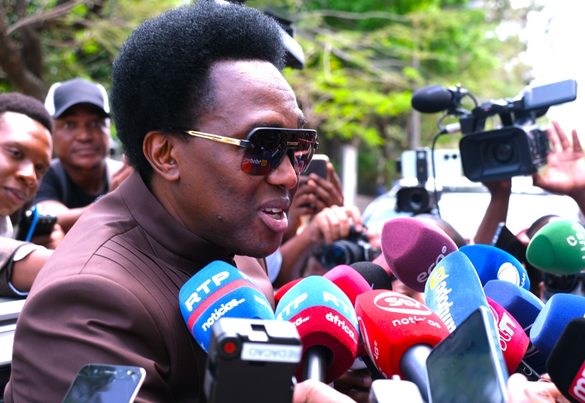
On leaving the court, Venâncio Mondlane said he was calm and that his defence team would rebut the prosecution’s case as if it were ‘slicing a loaf of bread’ or ‘peeling an onion’. (RD)
Note — The Mozambique Times (MOZTIMES) gained access to the courtroom at the invitation of Venâncio Mondlane. The Supreme Court hand-picked the media outlets it authorised to cover the trial from inside the courtroom.