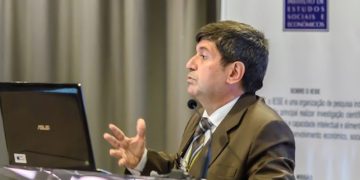



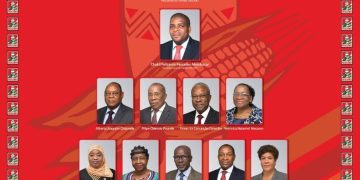




– Judge Carlos Mondlane asked the toughest questions
– Venâncio Mondlane answered every question, denying that he had instigated violence
By Ricardo Dias
Maputo (MOZTIMES) — The third day of Venâncio Mondlane’s trial was devoted entirely to the questioning of the defendant by the five judges hearing the case. Mondlane… answered every question. The questioning was so intense that, when it ended, the court decided to adjourn the hearing until the following day.
MOZTIMES reproduces below the questions put to Venâncio Mondlane and his answers. The account is as faithful as possible, based on notes taken by hand in a notebook. Audio and video recording are prohibited in the courtroom.
Judge Luís Mondlane: Your supporters joined the demonstrations you promoted, and infrastructure was subsequently destroyed. Why did you decide to continue?
Venâncio Mondlane: The prosecution puts forward many theories and conclusions that do not match the facts. There is no link whatsoever. There are 30 videos. Please play the part where I say, ‘Cause destruction, burn tyres, destroy factories and property.’
Judge António Namburete: When you called for demonstrations on 22 October, you reportedly said, ‘There’s no need to inform the police. We’re going to demonstrate across the country.’
Venâncio Mondlane: There was no offence or breach of the law on demonstrations that had any consequences. Those who commit offences during demonstrations can be isolated, but a demonstration does not depend on notifying the police.
Judge Luís Mondlane: You wanted all the demonstrators here in Maputo…
Venâncio Mondlane: I wanted the will of the people to be respected. The results were fraudulent. I am a politician and I mobilise the masses. I mobilise the masses for change. That already produced results in the 2023 election. For example, Quelimane was only returned to Renamo after demonstrations against the results. In Maputo, where I won, and in Matola, there was no change on that scale, but the number of seats in the municipal assemblies changed thanks to those demonstrations in 2023. We wanted the true election results.
Judge João Beirão: You always say ‘I’, but you end up saying ‘we’. Who are you talking about when you say ‘we’?
Venâncio Mondlane: I’m a politician. And we often use ‘WE’ to avoid attributing actions to any one person.
Judge João Beirão: Who set the times and dates?
Venâncio Mondlane: I did.
Judge Isabel Rupia: Could you foresee the destruction and the losses to the state?
Venâncio Mondlane: I was confident that everything would be just as it had been at the 45 demonstrations we led the previous year, which took place without incident. I was convinced of that. All I was calling for was inaction, not disorder. When I noticed what was happening, I made sure to respond immediately. Many members of the security forces disrupted the demonstrations. I could not have known there would be a false flag.
Judge Isabel Rupia: At what point did you respond during those three months of demonstrations?
Venâncio Mondlane: Whenever I became aware of a situation, I spoke out. These situations were provoked by members of the Defence and Security Forces. They vandalised warehouses and factories. Some people stole rice. The loss of life is linked to the actions of the Defence and Security Forces.
Judge Carlos Mondlane (CM): You refused to accept the results and set up your own government. You called for the election of heads of administrative posts and neighbourhood secretaries and called for the suspension of the electoral bodies, the governor, the secretary of state and administrators, and people took to the streets to blockade those institutions. There were even elections for new officeholders.
Venâncio Mondlane: It has to do with the political context. It was about removing those who had no legitimate claim to office. None of the bodies set up at the time usurped anyone’s functions. It was like setting up shadow governments. They have no official powers or public authority. For example, in Molumbo, in Zambézia, the two block leaders wrote to the administrator asking him to resolve a long-standing problem. What I see is that the authorities are using the law to play politics. (In the course of his answer, Venâncio Mondlane went on to set out the chronology of the investigation and prosecution.)
On 2 October, an officer from the National Criminal Investigation Service (SERNIC) told its national director that there was a plan to radicalise and paralyse the state. In other words, he was investigating me in the middle of the election campaign, despite the immunities I had as a presidential candidate. A year later, the same wording is being used to build the criminal case against me. The SERNIC officer said it was urgent to identify everyone involved and neutralise them, because Venâncio was co-ordinating them. That same day, a case was filed with the Attorney General’s Office (PGR) and assigned to prosecutor Paulo Armando Sitoe. That’s the speed we ask for. All of it on the same day. There was talk of the need to freeze accounts, seize passports and intercept calls. The judge authorised everything except the seizure of the passport.
Prosecutor Amabélia Chuquela: Let’s avoid naming the prosecutor. This is nothing personal. The Public Prosecution Service is not on trial.
Judge Carlos Mondlane (CM): The defendant allegedly called on the public to ensure that, if a citizen died, a police officer should also die or go to hell — the law of retaliation. After these remarks, members of the security forces were injured and killed.
Venâncio Mondlane: There was a lot of debate about that. It is in a priestly context. It is biblical language. Hell means ostracising those who killed innocent people. The law of retaliation was about holding people to account. It was about ending impunity. And the deaths did not happen afterwards. They occurred before those remarks. The videos do not prove who is being subjected to violence.
Judge Carlos Mondlane (CM): You said there would be damage to the economy and called on people to stop paying taxes and other levies.
Venâncio Mondlane: What damage are we talking about? What are the figures? How was the economy affected? What were the financial expectations? The demonstrations were peaceful. How does that affect the economy? In fact, since 1994, the year of the first elections, the economy has tended to contract in the two years following an election, usually by 6%. The common denominator is fraud. 2024 was worse because of the scale of the fraud.
Judge Carlos Mondlane (CM): You asked people not to pay tolls, and some groups told others, ‘President Venâncio said not to pay tolls.’
Venâncio Mondlane: The toll issue predates the elections. There had already been calls for people not to pay tolls. But that was never the same as refusing to pay. It was for people to boycott them. Not paying means not using them. It is a way of exerting pressure.
Judge Isabel Rupia: Are you aware that you caused terror in society?
Venâncio Mondlane: The worst terror is death. That was never the aim. We have evidence of how those people died. The Ministry of Health (MISAU) has it. I wanted to protest against Elvino Dias’s death and see the true election results recognised. Was I responsible? I was welcomed in Mozambique by orphans, widowers, widows, mothers who had lost their children and relatives of the victims. I was accused of terrorism on 2 October, while I was still campaigning — before Elvino died and before I called for demonstrations. It had nothing to do with my campaign.
Judge António Namburete: If it was all metaphorical, how do you explain the shadow government?
Venâncio Mondlane: It is political rhetoric that is meant to rally people and has a form of its own. The idea was to put an end to illegitimacy.
The hearing was adjourned. None of the preliminary issues raised at the start by the prosecution, the assisting party or the defence led to a ruling that could have changed the course of the trial or the day’s proceedings. This Friday, the prosecution will question the defendant. (RD)
Editor’s note. — The Mozambique Times (MOZTIMES) was given access to the courtroom at Venâncio Mondlane’s invitation. The Supreme Court hand-picked the media outlets it allowed to cover the trial from inside the courtroom.