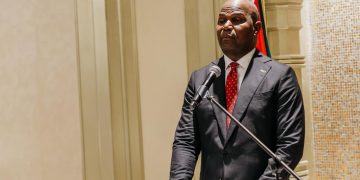


- Economic independence is the main pillar of Daniel Chapo’s administration, but economic results have been poor
- Terrorism in the north has intensified amid sharp disinvestment in defence
By MOZTIMES
Maputo (MOZTIMES) – Daniel Chapo marks this Thursday his first year as President of Mozambique. The period has been marked by post-election protests, a worsening of terrorist attacks in the north of the country, and an economic slowdown.
Chapo was declared the winner of heavily contested presidential elections held in October 2024, following the manipulation of results by the electoral management bodies, namely the National Elections Commission (CNE) and the Constitutional Council (CC).
There was evidence of major fraud during the elections, inflating the number of votes won by the ruling Frelimo Party. As the highest body in electoral matters, the CC could have ordered a recount, but it refused to do so, and thus fanned the flames of discontent.
The CC declared Frelimo and Chapo the winners, but the main opposition candidate, Venancio Mondlane, also claimed victory. In the absence of a recount, nobody knows who really won. The primary sources - the results sheets and minutes from the polling stations - were incinerated with suspicious haste, thus making a full recount impossible.
The fraudulent election results cast doubts over the legitimacy of Chapo's rule.
The post-election crisis that followed, characterised by rioting in several cities across the country, significantly constrained the first year of Chapo's administration. The greatest impact of the protests was on the economy, which recorded one of its worst performances of the past five years.
At his inauguration, Chapo defined the achievement of “economic independence” as the main objective of his government. However, key economic indicators from his first year in office are negative.
The main exception is the Liquefied Natural Gas (LNG) sector which recorded two notable developments during Chapo’s first year in power, with the announcement of the resumption of the Mozambique LNG project, led by the French company TotalEnergies, and the final investment decision on the Coral North floating LNG project operated by Italy’s Eni. Nevertheless, these developments have not yet translated into increased state revenues, as the projects remain under construction.
The President’s numerous foreign trips aimed at attracting investment have failed to produce visible results so far.
In the last quarter of 2024, economic growth contracted by around 5.7 per cent, falling to minus 3.9 per cent in the first quarter of 2025 and minus 0.9 per cent in the third quarter of the same year. These figures indicate not an economic recovery, but merely a slowing of the recessionary trend.
Inflation resumed its upward trajectory in 2025, compared to 2024. The annual rate of inflation averaged around 4 per cent, up from 3 per cent the previous year, in a context marked by supply-chain disruptions, foreign-currency shortages and exchange-rate rigidity.
The policy of artificially maintaining a fixed exchange rate of the metical against the US dollar, while helping to curb imported inflation in the short term, has caused distortions in the foreign-exchange market and worsened the shortage of hard currency.
Total public debt increased from approximately 1.044 trillion meticais in 2024 to around 1.068 trillion meticais by the third quarter of 2025, exceeding levels considered sustainable. Of particular note is the sharp rise in domestic debt, which grew from 396.1 billion to 444.1 billion meticais.
This has led to a significant increase in debt-servicing costs, due to the high cost of domestic financing, further intensifying pressure on public finance.
The growing reliance on domestic borrowing has also placed pressure on the banking system and generated adverse effects on the monetary system.
In response to the economic slowdown, efforts to contain the budget deficit have primarily focused on cutting social spending, with direct impacts on the quality and coverage of basic social services.
In the health sector, the budget for 2026 forecasts a reduction of around 4.3 per cent compared with the previous year, falling from 49.2 billion meticais in 2024 to 47 billion in 2026. The sector faces recurring crises, including strikes by doctors and other health care professionals, as well as shortages of medicines and medical supplies in healthcare units. The budget cut suggests that this crisis is likely to worsen.
In education, Chapo’s government adopted one of the most unpopular measures in the country’s recent history: the elimination of night classes from grades 7 to 12. This system was crucial for young people from disadvantaged families who needed to balance their studies with work, particularly in the informal sector.
The Ministry of Education announced that, starting in 2026, there will be a gradual phase-out of night classes, with no new admissions to Grade 7, ultimately leading to its complete elimination. As an alternative, the government is promoting distance learning, which many consider less effective.
Defence budget cuts and rising terrorist attacks
The fight against terrorism in Cabo Delgado is another area where Chapo’s government has performed poorly. During Chapo's first year in office, the defence budget was cut by more than 31 per cent, from 31.7 billion meticais in 2024 to 21.8 billion. A further reduction of around 6 per cent is planned for 2026, with the approved budget for defence of 20.3 billion meticais.
This disinvestment may have contributed to the deterioration of the security situation, as 2025 saw a significant increase in terrorist attacks, making it one of the worst years since the deployment of foreign troops in Cabo Delgado in 2021.
Throughout 2025, insurgents carried out attacks in almost all districts of Cabo Delgado, except for the city of Pemba, and expanded their operations into the neighbouring provinces of Niassa and Nampula, forcing the displacement of more than 100,000 people. Insurgents also resumed attacks on district capitals such as the towns of Mocímboa da Praia, Palma, Macomia and Nangade.
The government’s response ranged from inadequate to brutal. In addition to failing to contain jhadist attacks, security forces have increasingly targeted civilians, with serious incidents including the killing of fishermen in coastal areas and islands off Macomia and Mocímboa da Praia, attributed to the Mozambican Navy.
In major cities, organised crime continues to thrive. Kidnappings of businesspeople and their relatives for ransom remain a serious threat, while the police have largely limited themselves to arresting couriers or individuals involved in secondary roles, without dismantling the main networks.
Also in Chapo’s first year in office, a new criminal pattern emerged: the assassination of police officers assigned to special forces or holding command positions. At least six police officers were shot dead in public spaces, with none of the cases so far solved.
Chapo thus begins his second year in office under intense pressure, still trying to get the country back on track. (MT)