









- The business of selling Mozambican nationality is prospering before a lethargic judiciary that has apparently been captured by organised crime
- The DIC staff who have been charged for their alleged involvement in forging documents for foreigners are still at work, performing their duties
By MOZTIME
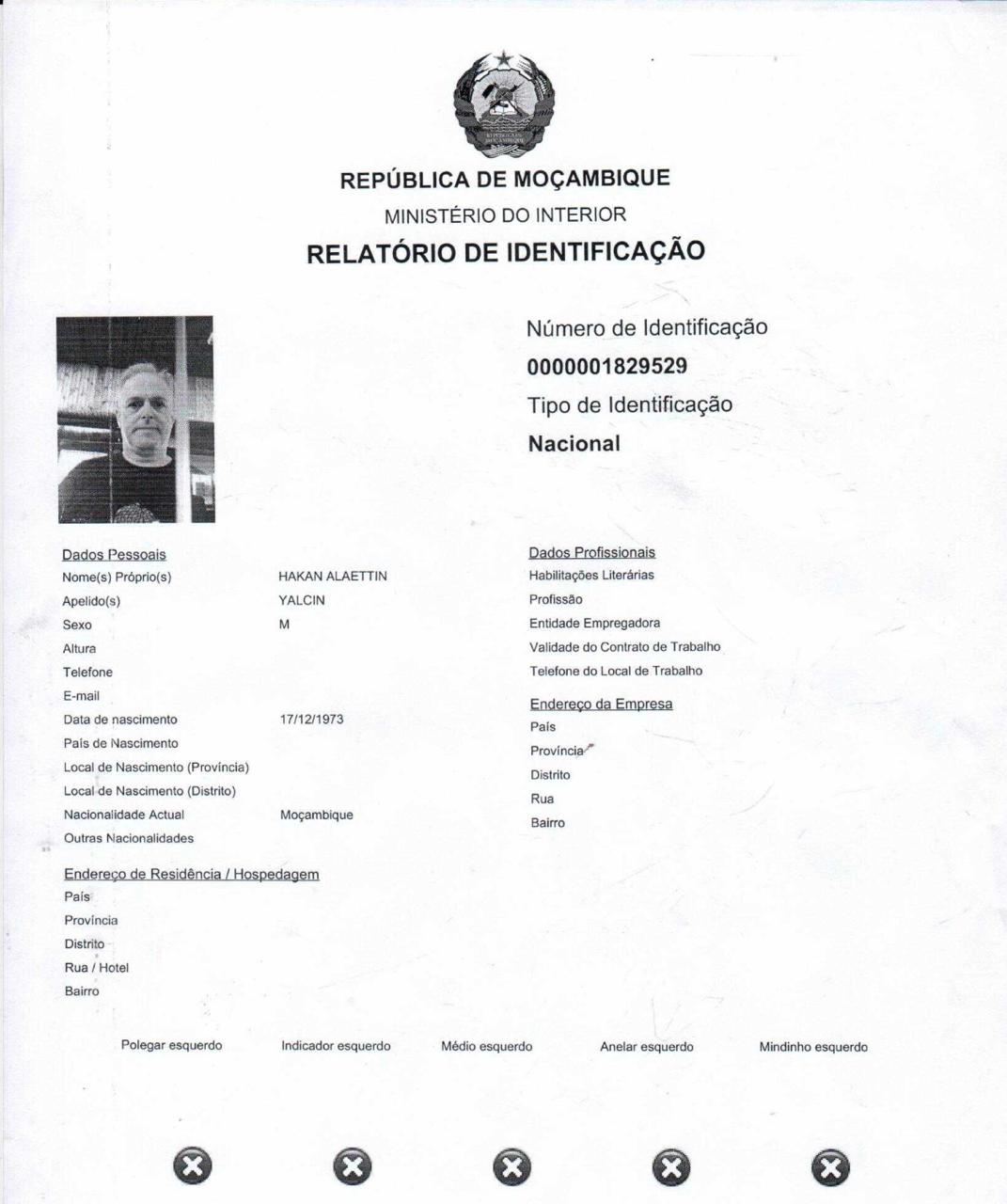
Maputo (MOZTIMES) – Two Turkish citizens, charged by the Public Prosecutor’s Office with forging Mozambican civil identification documents, used Mozambican passports obtained fraudulently to enter and leave the country for about a year, even after a public denunciation that the passports were false or purchased.
The situation shows how the authorities, who should have investigated the suspects, remained apathetic for a long time, allowing at least one of them to flee the country.
Immigration records consulted by MOZTIMES show that the Turkish citizens Semseddin Gaznevi and Hakan Aleattin Yalçin entered and left the country dozens of times between December 2023 and November 2024, using Mozambican passports. The records show that the two used the Ressano Garcia border with South Africa and one of them also used the border at Maputo International Airport, with the declared destinations of London (United Kingdom) and Lisbon (Portugal).
However, on 6 December 2023, the anti-corruption NGO, the Cente for Public Integrity (CIP) had published an investigative report denouncing that three Turkish citizens. Semseddin Gaznevi, Hakan Aleattin Yalçi and Devrin Sahutoglu, had acquired Mozambican civil identification documents illegally.
After the CIP denunciation, the Government set up an Inter-Ministerial Commission of Inquiry (CII), consisting of staff from the Ministries of Justice, Constitutional and Religious Affairs (MJACR), of the Interior (MINT) and of Foreign Affairs and Cooperation (MINEC), to investigate the case, In April 2024, the CII concluded that there really are cases of falsification of national civil identification documents involving the Turkish citizens indicated in the CIP investigation.
At the time, the MJACR announced that the Commission of Inquiry's report had been submitted to the Central Office for the Fight against Corruption (GCCC) and the Central Office for the Fight against Organised and Transnational Crime (GCCCOT) for legal proceedings against those involved.
Two years after the Commission of Inquiry concluded, those implicated have still not been held responsible, revealing a very slow justice system. The case began trial last week at the Maputo City Law Court, in a session marked by the judge's criticisms of the Public Prosecutor's Office for what she called its poor preparation of the case.
Also read: Judge Criticises Public Prosecutor’s Office in Case of Turkish Businesspeople Purchasing Mozambican Nationality
Furthermore, what seems more serious is that the foreign citizens involved in the forging of Mozambican civil identification documents continued to use fraudulently obtained Mozambican passports to enter and leave the country. The immigration records consulted by MOZTIMES show that the Turkish citizen Semseddin Gaznevi travelled several times between 18 April and 8 November 2024, using Mozambican passport number AB1198341 to enter and leave the country through the Ressano Garcia border. This happened after the denunciation by CIP and after the findings of the interministerial commission of inquiry were divulged.
For his part, the other Turkish citizen, Hakan Aleattin Yalçin, travelled between 3 March and 15 November 2024, using a Mozambican passport number AB1198809, through the frontiers at Ressano Garcia and Maputo International Airport.
These are individuals suspected of the crime of falsification of documents and of organised transnational crime, and allowing them to travel abroad, particularly by using documents obtained fraudulently, represented a serious flight risk.
The Central Office for the Fight against Organised and Transnational Crime (GCCCOT) drew up case number 82/GCCCOT/24 against the Turkish citizens accused of forging documents, and on 5 June 2025, the judge of the Criminal Section of the Maputo City Law Court, Cláudia Barros, issued warrants for the arrest of Hakan Alaettin Yalin and Devrim Sahutoglou, “since there are signs that they committed the crimes of aggravated Falsification of Documents and the use of false documents”.
Hakan Alaettin Yalin and Devrim Sahutoglou were detained on 13 August 2025 and held at the 8th Maputo precinct of the Mozambique Republic Police (PRM). It was not possible to issue an arrest warrant against Semseddin Gaznevi, because he fled the country during the investigations.
The Turkish citizens, who are businesspeople in the real estate sector, were later released on bail and are answering the charges in freedom.
Staff involved in falsification of documents are still performing their duties
Alongside the case drawn up by the GCCCOT, another case was drawn up by the Central Office for the Fight against Corruption (GCCC), against the three Turkish citizens and staff of the civil identification services accused of involvement in the falsification of the Mozambican identity documents issued to the Turkish citizens.
MOZTIMES ascertained that eight staff members of the Civil Identification Services were charged by the GCCC for their suspected involvement in the issuing of national identification documents for Turkish citizens.
They are Diogo Euler General – Civil Identification staff member allocated to Maputo city; Humberto Filipe Pedro Pateguana, who worked in the area of verification of data in the Identity Card factory in Maputo City, and is currently placed in Civil Identification Services in Matola; Sérgio Júlio Ubisse, who works in the area of validation of data in the Identity Card factory in Maputo City; Lemos Alfredo Matavele Júnior, who was allocated to the technical assistance area of the BI factory in Maputo city, and was transferred to the Civil Identification Services in KaTembe district; Hélio Fijamo, the Maputo City head of Civil Identification services; Samira Raul Nhari, Alegria Justino Quive and Zélia Filipe Sitoe, all data operators in the Maputo City Civil Identification services.
Of these eight, only Diogo Euler General was detained in the civil prison and, after his release against a Statement of Identity and Residence, he has not returned to work. The others are continuing to perform their duties normally, although they were interrogated by the Public Prosecutor’s Office as accused persons. There is no information on whether any disciplinary proceedings have been initiated against them.
A dangerous business rooted in society
The business of forging civil identification documents to confer Mozambican citizenship on foreigners is longstanding. It is rooted in society and has very negative implications for the country, including the risk of organised crime syndicates using Mozambican documents, such as passports, to commit crimes abroad.
Despite the seriousness of the crime, the judicial authorities have been slow and lenient in investigating and prosecuting criminal cases involving the falsification of Mozambican civil identification documents, leaving the criminal networks involved unpunished. It cannot be ruled out that organised crime is capturing the institutions that apply the law
In April 2022, the then Attorney-General, Beatriz Buchili, went to Parliament to tell the deputies “there are foreign citizens bearing passports and even identity cards issued by the national immigration and civil identification services who, by resorting to schemes of corruption, violate our borders, and operate in organised crime, putting at risk the sovereignty of our state”.
Four years earlier, in 2018, some 43 Nigerian citizens were detained in China for drug trafficking and all of them were carrying Mozambican passports. At the time, the immigration services said they did not know how the Nigerian traffickers had obtained Mozambican passports. Up until now the case has still not been explained.
This type of business does not involve only ordinary staff members of the civil registration services. In November 2025, a MOZTIMES investigation revealed that an ambassador and former Supreme Court judge facilitated a scheme for her son-in-law (who is of Mozambican nationality) to obtain Mozambican identification documents by falsifying the civil registration. Months have passed and there is no information that anyone has been held responsible, although all the evidence, including the forged documents, was published alongside the investigative article.
The lethargy of the justice system in taking action over the crimes of selling Mozambican nationality is an incentive to commit crimes. (MT)